Sunday, January 16, 2011

‘India listened to us only when we took up arms’

Part - 3 of 'From the Underground', a series of interviews for Tehelka Magazine.

The Naga rebellion has spawned many groups in the past 60 years. NSCN-IM’s Maj Gen Phunthing Shimray tells AVALOK LANGER that his outfit wants to bring all Nagas under one administrative umbrella

Nestled in the dense jungles of the Naga Hills, the Naga people’s movement simmers, ignored and unresolved. Since 1946, the Naga National Council (NNC) had championed the cause, but today, a new generation of separatists hold the reins of the movement.
Dissatisfied and unwilling to accept the controversial Shillong Accord, by which members of the NNC came overground and surrendered, Isak Chisi Swu, Thuingaleng Muivah and SS Khaplang broke away from the group and formed the National Socialist Council of Nagaland (NSCN) in 1980. With external support, the NSCN pushed towards self-reliance and sustainability. As it grew into a modern, organised and lethal movement, it lent support to other rebel outfits.

In 1988, the NSCN split into NSCN-IM (Isak Chisi Swu and Th. Muivah) and NSCN-K (SS Khaplang). Today, 10 years into the ceasefire, Nagaland’s demand for freedom remains intact. Excerpts from an interview with Maj Gen Phunthing Shimray, one of the new generation leaders, in Mokokchung:

What is keeping the Naga movement going?
When I go to India, they tell me, ‘You are a part of India, you should be happy that you have everything.’ But I want to be free, I want my right to choose. India’s claim to Nagaland is a legal one, because Nagaland was handed over to them by the British. But nations aren’t just born, they are created by people coming together. It is not about having a legal right, it is about the aspirations of the people and their right to choose. We never chose India. If the aspirations of a people are not met, there will always be conflict. For 200 years, the British ignored the aspirations of India and this gave rise to the Indian freedom struggle. Today, India is ignoring the aspirations of the Nagas and we are fighting for our right to self-determination.

The NSCN has been described as ‘the mother of insurgencies’ in the Northeast. Did it offer support to other movements?
If you are beaten up every now and then, won’t you raise your voice? Won’t you seek legal recourse? If the law fails you, then what, won’t you take it up yourself? It is not a question of helping them; it is about struggling people aspiring for their rights. India talks about 8 percent growth, but who is growing, my friend? Not the common man. India’s democracy is only benefiting the privileged few. Earlier, the Northeast was considered untouchable, it was ignored, a taboo of sorts. No one looked at us or heard our problems when we used the democratic process. But now that we have taken up arms, the Indians listen. We may have helped some of the organisations, but all of them have their own source: the people.

Rumour has it that the NSCN-IM actively helped the Naxal movement. Is there any truth in this?
Yes, we helped them, but not since the commencement of the ceasefire (10 years ago). For us, it is not about left, right, capitalist or communist. It is about the people, about their rights and aspirations.

What is your reply to those who believe that development will end the Naga insurgency?
It has been 60 years, if it had to, it would have died out by now. The Indian government pumps in crores every year but nationalism can’t be bought, it comes from the heart. Even if Dimapur and Kohima become like Kolkata, the movement will not die. Yes, there may be some who are taken in by development, but the numbers are with the movement. It is not about money, it is not about development. It is about our rights, our freedom and the uniqueness of the Naga people who can’t be bought.

The NSCN-IM leaders visited Delhi in March and submitted a list of 30 confidential demands. Some media reports said they had given up the demand for sovereignty and only want greater autonomy...What does greater autonomy mean to you?
To me, it means sovereignty. We cannot compromise on that, it is the right of the people, the will of the Nagas. In a democratic set-up, the will of the people is supreme. We also asked for separate passports. If I have a separate identity from you, wouldn’t I want my own passport? Nagalim (Greater Nagaland) has always been our goal, we have always wanted to bring all Nagas under one administrative umbrella. There is nothing new about that.


Like Jammu and Kashmir was given its own constitution, flag and special provisions, would you be willing to go down that path?
That is not an option. We don’t want a Naga version of Article 370. It has done nothing for the Kashmiris. It gave them all the power to run their state, but at the same time India took it all back. So, what’s the use? You need a home, a place you call your own, a place you can go back to. Once you have that, you can travel the world. Without that, you are a man without a country. For example, where do you originally come from? (I try to explain my confusing mixture of pre-Partition North West Frontier and Kashmiri lineage. He smiled and continued...) See, you didn’t fight for your homeland and now you have lost it. You are a man without a nation and that is a future we won’t settle for.

How do you react when people say that the Naga people’s movement is an insurgency? Does that bother you?
Bhagat Singh was called a terrorist once. People said he was just an angry man acting out of frustration, but he was not afraid to die for his beliefs. He was a one-man army battling the British, but he fought for his cause, his people. The British labelled him a terrorist, an underground element, but today, he is revered as a freedom fighter, a national hero.

When I was young, I saw my people struggling. That is why I wanted to help my people. I am pushed to lead my people by my conviction. I am who I am and you are who you are, but we must learn to accept each other for our differences. Then we can move forward, that is what I want.

‘Gandhi supported the Naga desire for independence’


Part - 2 of 'From the Underground', a series of interviews for Tehelka Magazine.

For more than six decades, a section of the Naga community has been fighting for freedom. Naga National Council veteran Thinoselie Keyho tells AVALOK LANGER why the battle is not over yet

Tucked away in the Northeast, a 60-year-old insurgency festers unresolved. Exposed to the nationalistic fervour that gripped Europe during World War I, Naga workers returning from France took the first step towards creating a unified identity by forming the Naga Club (NC) in 1918. As cohesiveness grew among the 16 Naga tribes, the NC gave way to the Naga National Council, under whose leadership, the struggle for freedom started.
Citing religious, historical and cultural differences with India, the Nagas wanted their own state. The tribes, who were conquered and ruled by the British, felt they should be left as they were: independent. On 14 August 1947, as the British Raj crumbled, Nagaland celebrated its independence day. The failure of talks and Prime Minister Jawaharlal Nehru’s aggressive policy propelled a strategic shift from political to military, and the Naga insurgency was born.

Lt Gen Thinoselie M Keyho, 80, has been one of the driving forces of the Naga National Council. Excerpts from an interview with one of the outfit’s seniormost leaders:
Why did the initial talks with the Indian government fail?
Nehru pounded the table and said that even if the sky falls, he or any other Indian PM will not give Nagas independence. Sometimes, I wonder if it was an outburst or a prophecy. Everything changed after Mahatma Gandhi’s assassination. He loved and encouraged us. He supported our decision to be independent. If he hadn’t been assassinated, well who knows...

What made you join the NNC?
I was asked the same question in Delhi.

Did you like Delhi?
Well, I spent four years in Delhi, all of them in Tihar Jail. I didn’t get to see much of the city. I was a political prisoner in the 1970s. I have lived through what the Indian government has done to the Nagas. I have seen it with my own eyes, heard it with my own ears. The Assam Rifles came to our village and killed two Gao Buras (village leaders). They tied them and put them on display at the village square. The troop leader mocked them as they lay there dead, tied to a bamboo pole. He warned us that we would suffer the same fate.

We weren’t scared. Instead of discouraging us, it angered us. We are tribals, we had to avenge their deaths, so we joined the movement. If violence begets violence, it was started by the Indian government. They started with the ballot war, but when it failed (the first national election was boycotted by the Nagas), India started the bullet war.
This recurring trend of “anger over fear” was explained to me by Kaka Iralu, the custodian of Naga history. It stems from the strong sense of our tribal identity. A Naga is never alone; we know our obligation, our duty to the tribe. If a Naga is killed by an outsider, it is our duty to avenge his death. Maybe fear by example was not such a good idea.

There are rumours that the NNC received training and support from the Chinese. Are they true?
If you want peace, prepare for war. The Indian government used peace talks (it offered general amnesty in 1957-58) to buy time to close in on us. But before they did, we went to China (in 1967-68). People still wonder how we managed that. Was it by car, bike, plane or train? they ask. With old maps and a compass, we walked. It was tough, we weren’t experts at using a compass and villages on the map weren’t on the ground and vice versa. All we had was our faith in God that we would make it. We received food and shelter from the locals as we moved from one village to another. Hunted by the Indian and Burmese army, we posed as a Christian peace mission to get by. When we reached near the Hokan Valley in Burma, the Kachin Independence Army took us under their wing and guided us to China.

What happened when you reached China?
The Chinese were not aware that we were coming. They were surprised when we crossed into the country and walked right up to their border camp. We were forced to stay at the camp for 10 days, waiting for the translators to arrive. It was tough to communicate before that because no one spoke English. Once the translators came and we explained our situation, everything was alright.


Then they took our boys to the barracks and trained them in combat, while Thuingaleng Muivah and I were taken to see some of the important places in China. The Chinese believe that “seeing is believing” and they wanted to show us how they were successfully building their nation.

We learnt a lot more from the Chinese than we did in Pakistan (East Pakistan 1962-63). While the Pakistanis had given us basic training and some weapons, the Chinese not only trained our boys to fight but also taught us military strategy and gave us political and psychosocial training.

What happened after that?
While Muivah stayed behind, I led half of the group back and we managed to sneak back into India undetected. Armed with AKs given by the Chinese (the NNCwas the first to have AKs in India) our morale was high as our boys, who were better trained and equipped, inflicted heavy losses on the Indian Army. All India Radio announced that both sides had suffered 300 casualties. It was then I knew that the Indian Army had suffered heavy losses. We were a group of 60 Nagas surrounded by 2,000 Indian soldiers. If Muivah had made it back from China, the situation in Nagaland would be very different today.

Having been a part of the Naga people’s movement from the start, what do you feel when you see Nagaland today?
Earlier, the Nagas were described as sincere, hardworking and honest people. Where are those qualities today? Nagaland has become a spoilt child; corruption and laziness are rampant and the Indian government supports this. When officials come from India, they are bluffed by the local officials. Even if 50 percent of what the Indian government gives to Nagaland is utilised effectively, we would be one of the most developed states in the country. Instead, we have 300-400 crorepatis awash in corrupt money. Corruption is not restricted to government officials and politicians, but it has crept into our boys as well.

What is the next step for Nagaland?
We can only move forward once the different factions (NSCN-IM, NSCN-K, NNC and FGN) resolve their differences. The summit for reconciliation held on 18 September is misleading. It was not inclusive and the groups are now voicing their reservations. I don’t know if this unity will last. We all need to sit together and have a face-to-face talk. A lot of blood has been shed and a lot of ill will has been created. We can never forget, but we have to forgive, whether we like it or not. India will take us seriously only if we are united and sincere. If the Indian government sees Nagaland as a political problem, then please send politicians, not the military. The army is taught to fight, kill and destroy, not to build. India has to be sincere in its efforts. The Nagas may be confused, but Delhi is even worse.

Is sovereignty still your demand? Are you willing to compromise?
We have fought for it and bled for it. We want independence. We are not worried about our economy. Our land is rich and our soil is fertile, our economy will grow. If India recognises our rights and our independence, Nagaland will be a good neighbour. As for compromise, I want 100 percent. But if the Naga people agree to 90 percent, who am I to argue otherwise.

‘For money, Dhaka turned a blind eye to our activities’


Part - 1 of 'From the Underground', a series of interviews for Tehelka Magazine:

After a 16-year insurgency against India, Julious Dorphrang is a disillusioned man. The former HNLC chairman tells AVALOK LANGER that Khasis must change from within, instead of blaming outsiders

Carved out of Greater Assam in 1972, Meghalaya’s statehood was only the first step towards its cultural preservation. Unemployment and the inability to compete with established nontribal businesses gave rise to discontent and anger among the Khasi, Jaintia and Garo tribals. The anger gave birth in 1978 to the Khasi Students Union (KSU), which fought to safeguard indigenous rights and culture.

Slogans of ‘Khasi by blood, Indian by accident’ gave way to violence. In 1987, three KSU men were trained by the Nationalist Socialist Council of Nagaland (NSCN). The Nagas, looking to destabilise the region, needed safe routes into Bangladesh and the Khasis had to fix their ‘outsider problem’. After the Hynniewtrep National Liberation Council (HNLC) was formed in 1993, the Khasi underground was born. After 16 years of rebellion, former HNLC chairman Julious Dorphrang surfaced in 2007. Now, he wants to do much more for his people. Excerpts from an interview with the former law student at his Mawlai (outer Shillong) residence:

Why did you join the Khasi underground?
When I was a student, there were no opportunities for the youth. There was no development. Building roads is not development; you have to build the village economy. As a KSU member, I saw the violence of the securitymen. We had to do something. With the moral, physical and financial support of the NSCN, we transformed ourselves into an underground movement. Once a businessman asked me why we do this. I replied that we do this because we want to draw the attention of those in power. They are now sitting on a pin — we are the pin — and they can no longer do as they please.

What was the HNLC’s goal? Sovereignty?
We never asked for sovereignty. We wanted the power to govern ourselves. Will Nagaland get independence? I don’t think so, but maybe Nagalim (Greater Nagaland) will be formed.

You established HNLC camps in Bangladesh. Did you get any official support?
Through my local contacts, I met a couple of high-ranking army and government officials. A colonel said to me, “Don’t you know our country is poor?” I said, “Yes, I know, but your heart is very big.” We had to use money power. Their support was not from the heart. It wasn’t like, since you are fighting India, I will support you. It was all about the money. Every border outpost has a Major in command. All you had to do was send Rs. 10,000 every Eid and he would turn a blind eye to our trans-border activities. Even the ISI had approached us through our general secretary Cheristerfield Thangkhiew to push fake currency into India. Though it was a lucrative proposition, I refused. Who would suffer? Not the Indian government, but the Khasis. To build camps, we targeted the Khasi villages in Bangladesh. They were being oppressed by Muslim zamindars. We paid off their loans and offered them protection. In return, we got some land where we set up our camps. The authorities knew about our activities, but they turned a blind eye.

Where did the HNLC get its arms from?
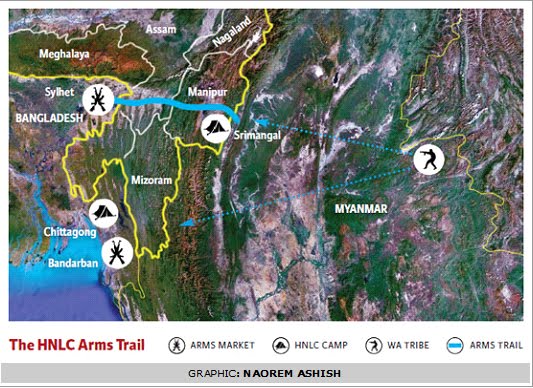
Once we had money, arms were never a problem. In eastern Burma (Myanmar) there is a tribe called the Wa. They are one of the most dangerous opium cartels in the world. Being of Chinese stock, they can easily cross into China to buy weapons for their private armies. After using them for three years, they sell them in the black market. They are picked up along the Indo-Myanmar border and then from Mizoram and Manipur are brought to the arms markets in Bangladesh (Bandarban and Sylhet). You can buy anything: AK-47/56, M-16s, RPGs, grenades, 9mm Berettas, etc.

How much did an AK rifle cost?
Depending on the honesty of the person you send, I’d say about two lakh taka (approximately Rs. 1.27 lakh).

Where did you get the money to buy arms?
The early years in Bangladesh were tough. Money wasn’t easy to come by. In every village that we used as a hideout, I set up a betel nut plantation. The pan made from betel nut leaf was popular and the locals would flock to buy them. We made Rs. 30,000 to Rs. 40,000 a day from each plantation.

Was the HNLC involved in extortion?
We imposed collection on businessmen. We would set an amount based on their income, which was open to negotiation. We also collected tax from petrol pumps (Rs. 5,000 a month), wine shops and corrupt government officials. We used our intelligence network to hunt officials dealing with black money. We tried our best to clean up the system. But in the long run, it was our boys who got corrupted.

How did the organisation maintain its popular support?
You can’t wage war with money. If I give you Rs. 10 lakh, will you love me? Only from the lips you will, not from the heart. I told my boys you cannot win the love of the people with money or guns. We had to help the Khasi people, make the society better. So to rid the society of rape, we launched Operation Kyllang (hurricane). Rapists were publicly punished. We would pierce a lock through their ear lobes, lock it and throw away the key. We would shoot him with one bullet (making sure it wasn’t lethal) and then drop him off at the hospital. We were able to successfully reduce crime in the Khasi Hills.


But that scenario has changed now...
The HNLC is nothing now and you can quote me on that. There are no more cadres (only 55 are left in Bangladesh). The experienced lot has vanished. (Commander- in-chief) Bobby Marwein and Cheristerfield just don’t care, they are not sincere. I became so disgusted and frustrated that I had to get out. I wasted 16 years of my life. I could have done so much more.

Do you get death threats from the HNLC now?
I don’t care about that. I have made my decision. Whatever happens, I am a man. One day, sooner or later, I might die (probably of) old age, or any eventuality that a man doesn’t know. That is the way of life. But I will not die at the hands of Bob (Bobby Marwein). That, I know. Some people say I’m a terrorist, a militant, but now I am overground. I want to live a normal life, be a good father and a good citizen.

What does the future hold for you?
I still feel depressed when I travel through my state. I want to do something before I get old, but I cannot do it alone. Sometimes, I get frustrated with the church. Why does the church talk against the HNLC? Why don’t they condemn the politicians who attend mass in their Sunday best? The church turns a blind eye to corruption. What is the difference between the HNLC and these politicians? We loot at gunpoint, they loot in suitcases. They are also terrorists. We should stop electing the same lot. Enough of blaming outsiders, the problem has to be fixed from within.

Tuesday, August 10, 2010

Homeless at Home

After unsuccessfully haggling with 3 auto drivers, I resigned to my fate. At 6’2 my attempts to ‘blend in’ with my surroundings here in the North East have failed miserably. In Nagaland I’m ‘plain maanu’, man from the plains. In Meghalaya I am known as ‘Dkhar’, an outsider. I am a non – indigenous, non – local, non – foreign, Indian outsider and fare game for all overcharging auto drivers.

Living in Delhi, a city of migrants, my sense of ‘me’ is not defined by land. Who is an original ‘Dilli Walla’? We all came from some where else. Delhi has had its share of communal blood shed, but for me, I can disconnect. There is no indigenous Dilli Walla, but with time anyone can become a local.

Here in the Meghalaya semantics has been politically mobilised. A fear of outsiders has gripped this state. An indigenous minority governed by an outsider majority, is the feared future. Protectionism is the need of the hour. In the on going indigenous versus outsider movement, it is the non indigenous locals who are suffering. They are homeless at home.

The Professor

‘My family has been in the North East for over a hundred years, I moved to Shillong in 1968 (Meghalaya got its state hood in 1972) but here in Meghalaya I’m not considered a North Eastern. How long does it take to become a local?’

The Professor smiled, seemingly resigned to his fate, as an Assamese of Bengali descent, he is just not North Easterner enough for Meghalaya.

Here it’s not about being a local, it is about being indigenous.

I spent the pervious night at Tango, a club in Police Bazzar. Sitting with friends and family, discussing the logistics of the after party, I happened to mention my subsequent meeting with the professor to one of my Khasi acquaintances.

‘Aawh, don’t listen to that Begali, he’ll only tell you lies.’ I smiled, sipped my beer and left for the after party. The following morning I found my way to Lower Lachumiere, the Professor welcomed me in and the ‘lies’ began.

‘The Bengalis and the Nepalese are the original settlers of Shillong.’ Seeing my confusion, smiling he pre-empted my interjection.

‘Shillong was a small hamlet, there was nothing here. The British came in and made it their capitol. With them they brought in the Bengalis to run their administration and the Nepali Ghurkhas to protect them. The locals (Khasis, Jaintias, Garos) settled down around the British set up.’

Sir, what about all these stories of discrimination by outsiders? Is it all unfounded?

‘No, no, it is true. There was a time when the non – tribals controlled the power and money. They had a head start and made the best of it. They were horrible to the tribals. They treated them with disrespect; they took advantage of the tribals. The tribal were backward and exploited.’

‘However today, where is the backwardness, where is the exploitation? You stand at any red light, watch the cars as they pass, see who is driving them and you’ll realise where the money is.’

Later: I took the professors suggestion, I stood at a crossing and observed. The percentage of drivers is heavily leaning in favour of the indigenous.

‘There is 85% reservation (40% Khasis + Jaintia, 40% Garo, 5% Smaller Tribes) in education. The remaining 15% is open so in reality, there is about 90% reservation. There is reservation when it comes to Government jobs as well. In the private sector, pressure groups like the KSU are pushing for indigenous employment.’

This isn’t a baseless claim by the Professor - Mr. Hamlet, the General Secretary of the KSU (Khasi Students Unions), stated ‘private indigenous employment’ as one of their objectives.

‘Out of the 60 assembly seats, 55 our reserved for the indigenous. Even large businesses are today controlled by them, though the Marwari’s are still the big players.’

‘They control the political power, they run the administration, they get all the benefits of reservation, how are they exploited? Today we are being discriminated, we are the minority. There is a steady exodus of the non – indigenous. How can we call a place home if we can’t own property, if we don’t have a stake in its future, if we can never be locals?’

‘If you look at Meghalaya today, there is still exploitation, but it’s the indigenous exploiting the indigenous. There is a percentage of the populous that benefits from the reservation, but at the cost of the majority. We as ‘outsiders’ can’t fix this, it’s on them.’

The Professor spent his Sunday morning sharing his experiences with me. We sat in his rented house, sipping tea, eating breakfast, talking.

Ghurkhas for Ghurkhaland

Vrinda* walked down the slope, passed the 15 dogs scattered across the drive way, in lower Mawprem. With dignity and grace she performed her daily chores with an ease that comes with experience. I saw her everyday, but never realised she was different. Standing a foot above the other Kongs, in the Meghalian matri - lineal society, she was the only one who wore sindhoor.

Born to a Shillong based Ghurkha couple, having never been to Nepal, she has no connection with her ‘home’. Raised in Mawprem, today a ‘rented’ Nepali ghetto of sorts, she too married into a third generation Shillong based Ghurkha family. She speaks fluent Khasi, which was more than apparent as Kha Par (my cousins’ aunt) translates for me.

With a smile she answered Kha Pars’ questions, how she could smile was beyond me. Having lived her whole life in Shillong, working to make ends meet, she doesn’t own an inch of land. As an outsider she can’t, she doesn’t have the right to own her home. Ironically, Ghurkhas can buy and own land in the UK, but not in Meghalaya, because here they are outsiders, non – indigenous.

My grandparents bought land and built a house to give my parents a home. My parents bought land, built a house to give my sister and me a home. Like any parents, they want to provide us with a secure future, a house that we can come back to, our home. Vrinda is no different; she put her life saving together and bought a house for her children. A house she will live in once she retires, a house they can call their own, a house three hours away, across a state border in Assam.

Vrinda was born in Shillong, grew up in Shillong, married in Shillong, gave birth in Shillong but she will die in Assam in a house away from home.

*Name changed

Just Another Bad Blues

There I was, leaning against a black, UP registered Opel Astra in the main Laitumukrah parking lot with the Khasi Bob Dylan, Lou Majaw. Across a black roof, over the reflection of the changing clouds, we talked shop and I was struck with a beautiful realisation, only in Shillong.

‘In my grandfathers’ time, Khasis, Jaintias, Garos, Bengalis, Assamese, Nepalese, Marwaris, all communities lived together, they lived in perfect harmony. There was no problem, no violence, no resentment. What new now? What has changed?’

‘It simple, it’s all about business. It about who gets the money, who gets the job, and who get the opportunities.’

‘The only difference between the insurgents and politicians is, the insurgents are underground criminals and our politicians, well they are ‘respected’ criminals. It’s all about money, it’s all about business. Today, politics is a job, insurgency is a job and business is a job, it just about who get what.’

‘Some folks just need an excuse and this (movement against outsiders) is the perfect excuse. There many people I know whose whole life is an excuse. There are always just passing the blame. People need to wake up and see reality as it is.’

‘People came here for the 3 W’s, Wine, Women and Weather. We here have been given a gift, why not share it? There is no problem. They (non – indigenous) have been here for ages, they didn’t come yesterday. All this (movement against outsiders) is,’ he paused and his deep, raspy voice he said, ‘just another bad blues.’

When land defines our identity, non - indigenous locals are stuck, landless, baring the burden of their ancestry. I am reminded of the Boston Tea Party, as the Yankees through boxes of tea over board dressed as the indigenous, American Indians, they shouted ‘no taxation without representation.’ Amazingly, here the indigenous have the representation but pay no taxes and the non – indigenous pay taxes but have no representation, no land and are considered an undesirable ‘burden’.

Saturday, July 31, 2010

The King and I


‘500 people crossed the border into Kargil and we went to war, but when 10 lakh Bangladeshis come into the North East we call it assimilation. There are days when I want to leave all this, will everything to my mother, pick up a gun and head to the jungle.’

Bordering Bangladesh, engulfed by ‘immigrants’, in a forgotten corner of the North East resides the oldest unbroken hereditary monarchy of the country, Tripura. I sipped Darjeeling tea as the passionate King, Pradyot Bikram Manikya DebBurman, opened my eyes to the ‘Tripura Situation’.

The Tripura Situation

(As explained by Mr. DebBurman)

After voluntarily acceding to the Indian state, Tripura has become a victim of the porous Indo – Bangladesh border. Years of illegal cross border migration, politics of assimilation and an ‘alien’ Bengali government, have left the indigenous tribals of Tripura a minority in their home land (roughly 30%). Numerically unable to capture power from the now indigenised, migrant Bengali (Bangladeshi) population (70%), the tribals have been economically isolated.

‘When I go through the streets, they (Bengali population) wave to me, seemingly show their respect, but I feel their hate, it comes out of their pores. To be looked at as an inferior, hated in my own Kingdom because I am a tribal King, angers me.’

It is this tribal anger, fuelled by economic backwardness, lack of ‘tribal’ opportunities and a sense of alienation from their political ‘representatives’( a Bengali dominated State Government) that has resulted in the ongoing underground movement.

Sitting in Delhi I was aware of the porous Indo – Bangladesh border and the growing illegal immigrant population, disconnected I thought, big deal. Living sheltered in a city of migrants, I never gave it much thought but as Pradyot spoke I was reminded of this fear psychosis I have encountered during my North East trip. A fear of outsiders has gripped this region. Tripura, where the indigenous are the minority, is the feared future. When the idea of home is violated, rationality becomes a luxury and ‘the outsider’, the non - indigenous become the enemy.

Why has the ‘pro – tribal’ movement turned into an independence struggle?

‘See what you need to understand is that the Tribal people of Tripura don’t hate Indians. They bear a resentment towards the Bangladeshis immigrants, but these immigrants are given citizenship and are now ‘officially’ Indians. So their anger gets misplaced, immigrants are confused for indigenous Indians.’

I understand the anger you must feel, made to feel like an outsider at home, but do you feel there is a workable solution?


‘The future lies in inclusive development, development of all without patronising any community. Today it’s not possible to get rid of the Bengali population, you have to work with them, build a joint tribal, non – tribal future. The first generation of immigrants wanted land, the second generation wanted jobs, but today’s generation wants more. They want cinemas, night clubs -development. If your car has a flat tyre you change it, but today they (State Government of Tripura) say, let the other three tyres carry the weight. You can’t have that, can you?’

You talk of development, but what I have noticed in the North East is that there is no private sector. The main source of youth employment, the Government, is the now saturated. Where is the development?

‘There is a class here in the North East, within our own communities, which is successful because they are the intermediaries between GOI and the people here. This creamy layer, directly benefits from keeping things the way they are.’

‘For development private entrepreneurship is important, tourism can play a big role. You don’t have to be in a big town, you can be in Cherrapunjee and develop Cherrapunjee. The BPO industry can be big in the North East. I think 60% of the BPO industry outside consists of students from the North East. They are working for seven thousand Rupees in Delhi, Bombay, in a Metro that’s nothing. You give them six, seven thousand rupees here they will be much happier. But how will you have a BPO industry when the BSNL connection breaks every 10 minutes? How will you have a boom in tourism when the infrastructure is poor?’

‘The truth is nobody is listening to the people and as long as no body is listening to the people you will have a problem. Nobody listened to Jessica Lal’s case, or the Arushi’s case, but then the media heard them and it became a movement.’ Echoing a sense of ‘media betrayal’ common in Nagaland, Arunachal and Meghalaya, emotionally charged Pradyot explained, ‘Here even the media is not there, the main stream media is just not interest (in the North East).’

This media betrayal is real. A boy fallen in a well becomes a ‘heart warming’ breaking news story flashed across our TV screens for days, but when it comes to TRPS the North East just doesn’t sell. An integral part of our nation was blockaded for over two months, but Dhoni’s secret marriage had more on ground coverage. Channels opt to have one token North East correspondent. One report based in Guwahati to report on 8 states of the North East.

But in the spirit of ‘God helps those who help themselves’, I asked,

I agree with what you’re saying, I came across the same sentiment in Nagaland. But every five years you elect your representatives; you can’t just abdicate the blame and point fingers.

With a knowing smile Pradyot explained. ‘I know yaar, we don’t elect a Government, we don’t have an option. As a politician, five years ago, I would say exactly what you saying – “You have a choice”, but its a piece of paper I gave you and tell you “Now you have the power to choose your future” and every five years I come back and say “now choose your future”. Who do you choose, are you deciding who will be a candidate. Tickets are bought.’

Interrupting rhetoric I had heard many times, with a slight air of arrogance I said,

I agree there is a lot of corruption, but as a government you can’t function if there is popular discontent...

Returning the favour, Pradyot cut me short.

‘But there is popular discontent and there will be more popular discontent in the years to come until you don’t bring in effective development. This popular discontent is causing the government to fall every four months. Meghalaya has had 39 Chief Ministers since it became a state in 1972. Each option is as bad as the last.’

Political corruption, creamy layer exploitation, economic backwardness this is the common story of India, excuses we give ourselves to fail. Is there a solution?

‘As a King, my people have given me a lot. Everything stems from them. I don’t want to me just another Maharaja, Mooch upar kar ke, polo khelne nikle. I feel for my people, I want to better their lives and I will do it, but I will do it my way. Unfortunately I can’t do it alone but I have always believed that the youth needs to step up, take responsibility and enter politics. I have a team of young people working with me, we will changes things.’

Relived to hear hope escape the Kings lips, I posed to two questions, how do you expect to get power in Tripura, when tribals are in a 70 – 30 numerical minority, how will you get the numbers. Also could you elaborate on what you mean by ‘your way’?

‘My way, is the youth taking responsibility for themselves, the future rest on the youth. As for getting power, I will simply talk development. As I mentioned before this third generation of Bengali ‘immigrants’ wants more, I will give them that. I will develop tourism, hotels, create jobs. Bring in the BPO industry, invest in power generation, education. Why should we only trade with the mainland (India), I will open up traditional trade routes with Bangladesh and Burma. The future lies in economics.’

‘I am young and therefore emotional and uncompromising on my ideals. There are days when I want to leave all this, will everything to my mother, pick up a gun and head to the jungle. Maybe time will ease my passion, but for now I will not compromise. The sad fact is the government of India takes the North East as a strategic part of the country, strategic not integral.’

Friday, July 23, 2010

The Original Underground - Part 1


‘AIR announced, both sides had suffered three hundred casualties’, he paused and smiled, ‘it was then I knew that the Indian army had suffered heavy losses’, he chuckled, ‘we were only a group of 60 Nagas surrounded by 2000 Indian soldiers.’ His smiled faded.

‘If Muivah had made it back from China, the situation in Nagaland would be very different today.’

As Lt. General Thinoselie M. Keyho, of the Naga National Council (NNC), shared his experiences with me I noticed an uncanny similarity between the General and my grandfather. Here I sat with the ‘enemy’, a Lt General of the NNC (the first Naga ‘underground’ group) but his mannerism, his sense of dressing, the grey cardigan, his style of speaking took me to the image of my grandfather; a sword of honour and a highly distinguished Lt. General from the Indian army. Amused and lost in a sense of realisation, I asked:

What made you join the NNC?

‘I was asked the same question in Delhi’

Being from Delhi I asked; Oh, so you were in Delhi. Did you like it? My attempt to build bridges wasn’t very successful.

‘Yes, I spent 4 years in Delhi’, he laughed ‘all of them in Thihar, I didn’t get to see much else. I was a political prisoner in the ‘70’s.’

Sensing my discomfort, he continued.

‘I was interrogated in Delhi Cant, they asked me the same question:

- “Why did you join the underground?”

- “Who misguided you?”

‘I have lived through what the government of India has done to the Nagas. I have seen it with my own eyes, heard it with my own ears.’

‘The Assam Rifles came to our village, they killed two Gao Bura’s (GB – Village Leaders), they hog tied them and displayed them in the village square. The troop leader mocked them, as they lay there, dead, tied to a bamboo, he told us we would suffer the same fate.’

‘We weren’t scared, we weren’t criminals, we aren’t monkeys, instead of discouraging us it angered us. We are tribal’s, we had to avenge their deaths, so we joint the movement.’

‘If violence begets violence, it was started by the Government of India. They started with the ballot war, but when it failed (first national elections were boycotted by the Nagas), GOI started the bullet war.’

Kaka Iralu, the custodian of Naga history, explained this recurring trend of ‘anger over fear’ to me. It stems from the strong sense of tribal identity prevalent amongst the Naga’s. A Naga is never alone, their motto could very aptly be “all for one and one for all”. ‘We know our obligation, our duty to the tribe. If a Naga is killed by an outsider, ‘it is our duty to avenge his death.’ Maybe if the Indian forces were aware of this tribal mindset, they would not have perused the path of ‘fear through example’.

How did the Naga People’s Movement begin?

‘Nagas have a strange history, we have been described as naked backward head hunters. We were head hunters, there is proof of that, and until very recently (1966 Mon district) we were naked, but backward I don’t think so.’

He stops, smiles, takes a sip of tea and continues.

‘I would argue with Phizo that though we couldn’t read and write, we weren’t backward because we as Naga’s realised that we were independent and fought for our freedom. Though our neighbours the Khasis and Manipuri’s were more educated then us, they were less politically aware. Our demand for freedom began well before India’s independence in 1947.’

A brief over view of the origin of Naga People’s Movement

Inspired by the nationalistic fervour of Europe, the Naga workers returned from France and in 1918 took the first steps to create a unified Naga identity, the Naga Club. The ball was rolling, work was on to create a greater Naga identity, develop a feeling of oneness amongst the tribes. As time progressed, the Naga Club gave way to the Naga National Council and the internal process of unification to an external demand for freedom. Sighting religion, race, traditions, customs and language as irreconcilable difference with India, they demanded that the British do justice by them. Logic being, pre – British, they were independent, the British conquered and ruled them directly, therefore post British they should be left as they were, independent.

I have heard the NNC received training and support from the Chinese, is that true?

‘If you want peace prepare for war. The government of India used ‘peace talks’ (GOI offered general amnesty 1957-58) to buy time to close in on us, but before they did, we went to China (1967-68).’

Previously to expand the Naga movement from a political to a military domain, the NNC had reached out to Pakistan. They ventured across the border and received arms and ‘action’ training in East Pakistan, 1963-64.

‘General Mo (President FGN) and I suggested that we send our boys to China. May be since I suggested it I was asked to go. We set off with old maps, a compass and just our faith in God, that we would reach China.’

How did you go to China?

‘People still wonder how we went, they ask, was it by car, bike, plane, train? How do you think we went?’

Not sure if it was a rhetorical question, I remained silent with an expression of frozen ‘intelligence’.

‘We walked, moving from village to village through Burma. Villages on the map weren’t on ground, those on ground weren’t in the map. Hunted by the Indian and Burmese army we posed as a Peace mission. We received food, shelter and support from the locals. It was when we reached the Hokang valley in Burma that the Kachin Independence Army (KIA) took us under their wing and guided us to China.’

Oblivious to the Chinese, Th. Muivah, Lt. Gen. Keyho and over a hundred soldiers of the Naga Army walked towards China. With their faith in God and the belief that with China’s help they could militarily defeat the Indian Army, they walked.

To be continued...

Monday, July 19, 2010

Don’t Blame Us, Blame Manipur


‘If they can have a blockade, so can we, no vehicle with Manipuri registration will enter Naga areas, none of the Naga areas.’

Before I embarked on the North East leg of my journey, Nagaland was in the news for all the wrong reasons. News channels gave us the ‘facts’,

Fact One: ‘The Naga’s have imposed a crippling economic blockade on Manipur’

Fact Two: ‘The blockade has been carried out by Mr. Muivah supporters, in response to him being denied entry into Manipur.’

Fact Three: ‘Manipur is suffering under the huge price rise caused by this Naga blockade.’

There is an undeniable truth to these ‘facts’, but as I have realised there are always multiple truths and co-existing facts. I sat in the Naga Student Federation’s (NSF) office in Kohima, armed with these ‘media facts’, as Mr. Mutsikhoyo Yhobo, president NSF, explained the Naga version of the Manipur blockade.

Pointing to the board of Presidents pre-dating 1947, Mutsikhoyo explained,

‘The Naga Students Federation is one of the oldest civil societies in Nagaland. It pre dates both the NNC and NSCN. The aim of NSF was to bring all the Nagas under one administrative group, irrespective of their state or country of residence. Our traditional jurisdiction covers all Naga areas within India (Nagaland, Manipur, Assam, and Arunachal) and Burma. Even today our mandate applies to these areas.’

You can imagine the ego clashes and turf wars created by Naga civil societies claiming their historical jurisdiction in Manipur. Technically between two states of one nation, a little jurisdictional spill over shouldn’t matter. If only it was that simple.

The Blockade

‘As I mentioned before, the jurisdiction of NSF stretches into the Naga Hills of Manipur. We have previously held many functions, meetings and forums in these Naga areas without incident. There has never been a problem in the past.’

I furiously scribbled into my notepad as Mr Yhobo, explained the events leading up to the ‘Naga Manipur Blockade.’

‘We wanted to hold our Third Federal Assembly in Senapati District of Manipur in early May. In April itself we informed our local leadership to organise the formalities and a month later, on May 3rd we set off towards Mao Gate.’

Mao Gate is the border crossing between Manipur and Nagaland on National Highway 39. It would play a central role in the Naga – Manipur stand off over the next two months.

Stopped by armed Manipuri security forces at Mao Gate, the NSF leaders questioned the IGP present.

‘We asked him why we were not allowed to enter Manipur. Without clarifying or offering us any real reason, all he said was “It is an order from higher up, Naga’s are not allowed.” To ensure we could not proceed, the security forces had blocked the highway with big boulders. They started the blockade, they blocked the highway first.’

Insulted and infuriated the NSF contingent headed back to Kohima headquarters to hold a meeting with higher leadership. This meeting resulted in an ultimatum served to the Manipur CM.

‘Withdraw Manipur Rifles and Commandos from all Naga areas within twenty four hours’, expiring, 4th May, 6 p.m.

Failing which,

‘If they can have a blockade, so can we, no vehicle with Manipuri registration will enter Naga areas, none of the Naga areas, but let me clarify. This blockade was not an economic blockade, but it was an agitation to show our resentment to the Manipur government.’

I threw in a question; The Delhi media has been reporting that the blockade was put in place by Mr Muivah’s supporters in response to him being denied entry into Manipur, is that so?

‘We launched our movement independently. At that time we were unaware of Mr. Muivah’s movements towards Somdal. In fact even before he reached Kohima on the 6th we had launched our agitation.’

But Mr. Mutsikhoyo, the media reports stated that the Manipuri forces opened fire on Muivah’s supports protesting at Mao Gate?

‘That’s not true, the local Mao community started a peaceful protest against the Manipuri Security Forces blockade of Highway 39. Without any provocation the security forces opened fire on the procession. Two students we killed, over a hundred were injured and the Mao community was displaced due to harassment by the security forces. This blockade was created by Manipur.’

I understand that your blockade was an agitation, a show of resentment, but what about the Manipuri people who suffered from the price rise?

‘The Meiti community is using the media against us. There is an influential Meiti women’s organisation, Meira Pabi, they forcibly closed down the grocery shops and petrol pumps. This led to the shortages, not the blockade. They used the media to put the blame on the Nagas.’

Seemingly relinquishing all blame, the NFS President continued.

‘The Meiti community had ordered a quit notice to the Hindi speaking population residing in Manipur. They had ordered these non – locals to move out by the 31st of May and then denied them transport to leave. If the Meiti community can not coexist with Hindu, Hindi speaking people, (since the Meiti’s are Hindu) how will they mix with Christian Naga tribals?’

He paused and looked at his ringing phone. I used the opportunity to ask a question. You recently visited Delhi, you held a press conference (the press conference was given 2 minutes of air time by main stream media) and spoke to central ministers, could you elaborate?

‘The Meiti’s had been using the main stream media to their advantage, we were being made into villains. We wanted to get our voice heard.’

‘We first met the Home Minister, he told us’

“I been aware of the of the Naga issue since my school days, today I am a national leader and the issue continues unresolved. I do not want to pass it on to another political generation. The UPA and I are sincere in our efforts.”

The Home Minister continued.

“To block a national highway for a day or two, to make a point, is understandable. But for months, that’s not correct. The highway does not belong to anyone, even if it passes through your state you do not have the right to block it. You should feel happy that you have a national highway connecting your state, other states do not have this privilege. You must end your blockade.”

‘We told the Home Minister, that we could only call off the blockade once we returned to Nagaland. We told him, the sooner we meet the Prime Minister and other leaders, the sooner we can go back and decided on the blockade. Though not officially, it was the Home Minister who expedited our meeting with the Prime Minster.’

‘The Prime Minster told us, the Government is like a parent,

“We do not want our children to fight, even if one child wants to leave the family. The Naga issue is very sensitive, we can’t solve it immediately. We need to make your neighbours understand the situation, until they understand, the problem will continue.”

‘Even the PM said he wished to find a solution during this UPA term. He wanted to work closely with Naga student and youth leaders to find an honourable solution.

What issues did you put forward to the Government?

‘There were three main issues that we discussed with the Government.

- Until the Indo – Naga political issue is resolved, the crisis will continue and things will remain on edge. If it is solved, 70% of the North East issues will be resolved (It is well known that majority of the secessionist movements in the North East receive material, training and ideological support from the Naga underground).

- We discussed our goal of bring all Nagas under one administrative group.

- We discussed the Autonomous District Council Act had how it would lead to the oppression of Nagas and Naga culture in Manipur. We stressed that decisions should be taken with the consent of the people.’

Having interacted with the central government, what do you think the future holds for Nagaland?

‘From my interaction with national leaders, the leader of opposition and youth leaders like Rahul Gandhi, I have seen the government’s attitude and sincerity. I’m hopeful that some positive changes will come through this UPA government.

What about independence?

‘Independence’ he smiles ‘we are not part of the peace talks and it is not in the NSF jurisdiction to discuss or voice demands for Independence’, he leaves it at that.

It seems that only drastic measures like a blockade will make ‘main land’ India take notice of the North East. I’m not trying to point a finger at the centre, which is fighting to integrate the North East. The blame lies on millions of ignorant Indians.

Development, jobs and peace are the need of the hour, but voiced or held in silence, independence, is close to Naga hearts.